
Anisse
(replying to Anisse)
I could not resist, so for day 23, I wrote an edge-reduction (+trivial dead-end elimination) solution, and it takes ~300ms in release mode.
I still have no regrets because it took me longer to write than the time to write and run my first naive bruteforce solution.
On the plus side: I generated a graphviz of the reduced input which helped understand why it was needed:

Anisse
(replying to Anisse)
I solved part 1 in an average time (for the later days); the real problem was part 2. I did not know how to approach the solution for a long time; so this was definitely the hardest problem this year.
After failing to solve part 2 in Wolfram Alpha (reaching the limit of characters), I ended up writing a bruteforce solution which found the solution from the example pretty quickly. But as I had guessed, it did not work for the much bigger input. I did not let it run for more than 1 hour.
So the next day, I caved and started to learn how to use z3 with the rust bindings crate. It took some wrestling (no examples, buggy build on fedora fixed in git but with no new crate), but I managed to do it, and it finds a solution in a few seconds.
I now know it can be solved in ~constant time, but I was too tired to re-write (again) the equations to solve them, or to learn about and implement Gaussian Elimination.
Anisse
(replying to Anisse)
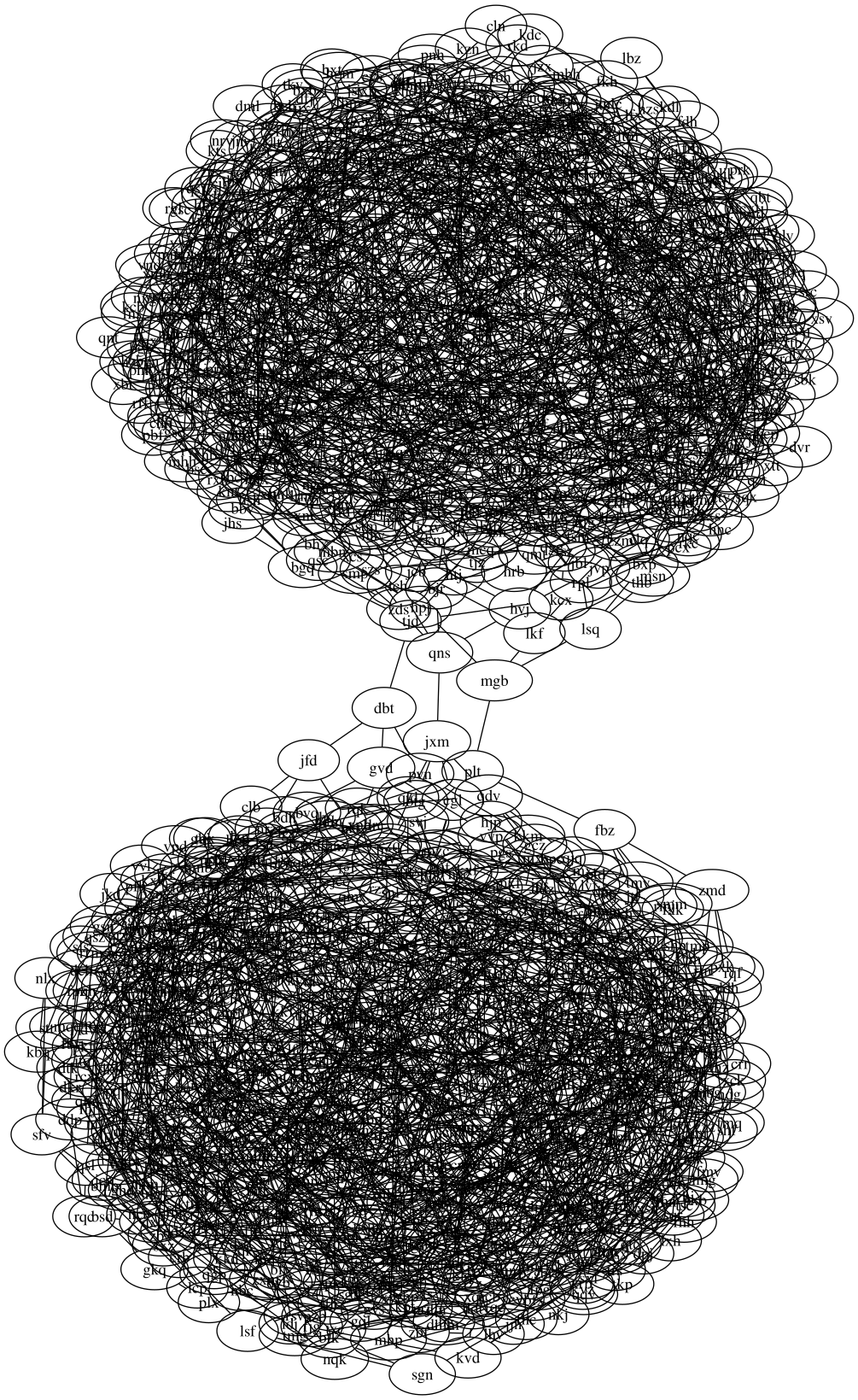
As I saw the problem today, I was reminded of how useful was visualization on day 20.
So I immediately tried to learn about the dot language (that was fast), and whipped up some awk to convert the input. The three connection edges were quickly apparent, so I removed them manually, made the other edges bi-directional and counted the nodes on each part of the graph.
I know there is a simple graph-theory solution with flows, but that will be enough for me for this year's AoC !
Anisse
(replying to Anisse)
It's the second year in a row that I'm able to complete AoC. And I'll be honest: this was though. The break-neck pace of doing one full solve per day requires that one either has a lot of free time, or has previously spent a lot of free time getting better in order to solve the puzzles faster. I do it because it's fun, and it still was; but I'm aware that it's walking over the not-fun line as well.
I was able to do it, but it was not cost-free. I think I might go for a lighter pace (or skip) next year.
On a positive note, I still learned a lot this year, and that's one of my personal goals 🙂
Anisse
(replying to Anisse)
I summarized everything I learned from completing this year's Advent of Code in Rust: https://anisse.astier.eu/aoc-2023-lessons.html
It is mostly spoiler-free and does not talk about any specific problem.